
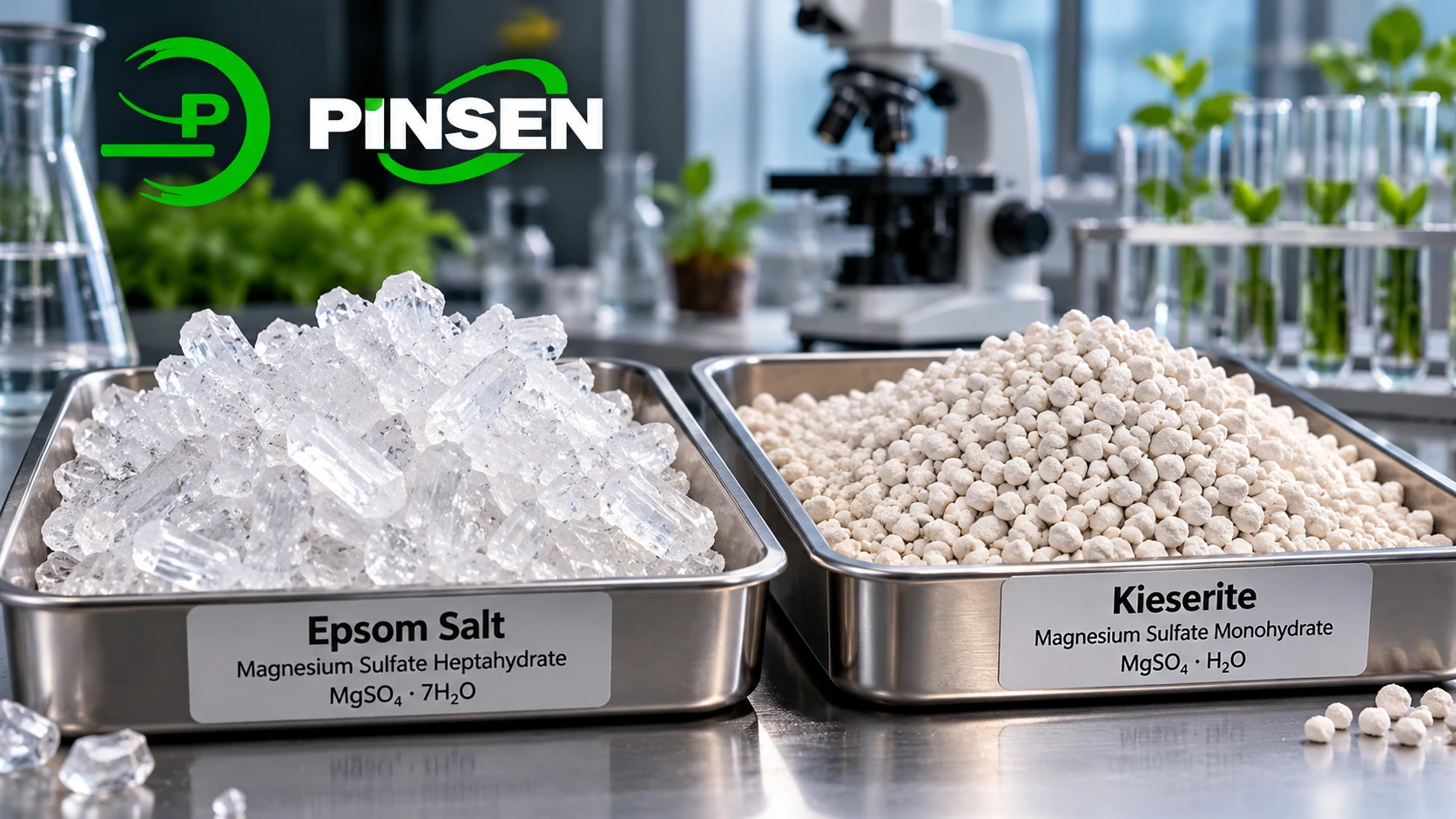
Magnesium and sulfur are essential secondary macronutrients required for high-yield crop production, yet they are frequently overlooked in standard NPK fertilization programs. For agricultural distributors, fertilizer blenders, and large-scale farm purchasers, selecting the correct magnesium source is critical for maximizing nutrient efficiency and protecting profit margins.
When sourcing bulk magnesium fertilizers from China, global buyers typically encounter two primary mineral forms: Kieserite and Epsom Salt. Although both compounds provide vital magnesium and sulfur, their chemical structures, solubility profiles, and optimal application methods differ significantly. As a leading direct source manufacturer, PINSEN explores these differences to help you choose the right product for your target market.
Understanding the Chemical Foundation
To make an informed purchasing decision, it helps to look at the molecular makeup of each product:
- Kieserite (Magnesium Sulphate Monohydrate): Chemically designated as $MgSO_4 \cdot H_2O$, Kieserite contains a higher concentration of active magnesium (Total MgO typically $\ge 27\%$) because it possesses only one molecule of crystal water.
- Epsom Salt (Magnesium Sulphate Heptahydrate): Chemically designated as $MgSO_4 \cdot 7H_2O$, Epsom salt contains seven water molecules, resulting in a lower active magnesium content (Total MgO around $16\%$). However, its crystal structure offers exceptional water solubility.
For commercial buyers purchasing by the metric ton, these chemical variations directly influence maritime freight costs, storage behaviors, and field performance. To secure the ideal formulation for your inventory, explore our range of PINSEN granular Kieserite (monohydrate) designed for broadacre agriculture.
Agronomic Performance: Soil Broadcasting vs. Foliar Feeding
1. Soil Application and Bulk Blending (The Strength of Kieserite)
In regions with high rainfall or sandy soils prone to nutrient leaching, fast-dissolving fertilizers can wash away before crops absorb them. Kieserite dissolves at a moderate, steady pace. This makes it an ideal choice for direct soil application or as a raw material in Bulk Blending (BB) NPK fertilizers.
Furthermore, PINSEN’s high-hardness extruded Kieserite granules match the physical density of urea and DAP, minimizing product segregation during mechanical spreading and preventing dust issues during port handling.
2. Instant Correction and Fertigation (The Advantage of Epsom Salt)
When crops display severe signs of magnesium deficiency—such as interveinal chlorosis in older leaves—immediate remediation is required. Because of its high purity and fast-dissolving transparent crystals, PINSEN Epsom salt crystals (heptahydrate) dissolve completely in water without leaving insoluble residue. This makes it the preferred option for greenhouse drip irrigation systems, pivot fertigation, and high-value foliar spray programs.
Technical Comparison Matrix
| Feature / Parameter | Kieserite (Monohydrate) | Epsom Salt (Heptahydrate) |
|---|---|---|
| Chemical Formula | $MgSO_4 \cdot H_2O$ | $MgSO_4 \cdot 7H_2O$ |
| CAS Number | 14168-73-1 | 10034-99-8 |
| Total MgO Content | $\ge 27.0\%$ | $\ge 16.0\%$ |
| Physical Appearance | Off-white / Colored Granules or Powder | Translucent White Crystals (0.1mm – 6mm) |
| Release Rate | Controlled, steady soil release | Rapid, instant dissolution |
| Primary Use Case | Soil conditioning, BB fertilizer blending | Foliar sprays, drip irrigation, bath salts |
| Freight Efficiency | Higher active nutrient per ton | Lower active nutrient per ton |
Sourcing Considerations for Global Importers
When issuing purchase orders for bulk chemical fertilizers, international procurement managers must evaluate several operational factors:
- Logistics and Freight Costs: Because Kieserite contains less crystal water, buyers import more active magnesium per container, optimizing ocean freight expenses per effective nutrient unit.
- Anti-Caking and Packaging: Both products require robust moisture protection during long ocean transit. PINSEN utilizes heavy-duty PP woven bags with thick PE inner liners and 1250kg Jumbo Bags to guarantee safe delivery across humid trade routes.
- Quality Assurance: Always demand verified Certificate of Analysis (COA) reports verifying low heavy metal thresholds (Lead, Arsenic, and Cadmium) to comply with local agricultural and environmental regulations.
Frequently Asked Questions (FAQ)
Q1: Can Epsom Salt be used as a direct substitute for Kieserite in dry fertilizer blends? A: While both supply magnesium and sulfur, Epsom salt has a higher moisture content and lower bulk density than Kieserite, making it more prone to caking when mixed in open bulk fertilizer blends. Kieserite granules are engineered specifically for dry mechanical spreading and BB fertilizer mixing.
Q2: What is the standard Minimum Order Quantity (MOQ) for PINSEN magnesium sulphate products? A: Our standard MOQ for international ocean export is 27 Metric Tons (1 x 20′ FCL), ensuring optimal container space utilization and cost-effective freight rates.
Q3: Does PINSEN provide third-party pre-shipment inspection? A: Yes. We regularly accommodate independent testing and weight verification by agencies such as SGS or BV upon client request prior to vessel loading from Qingdao or Tianjin ports.