
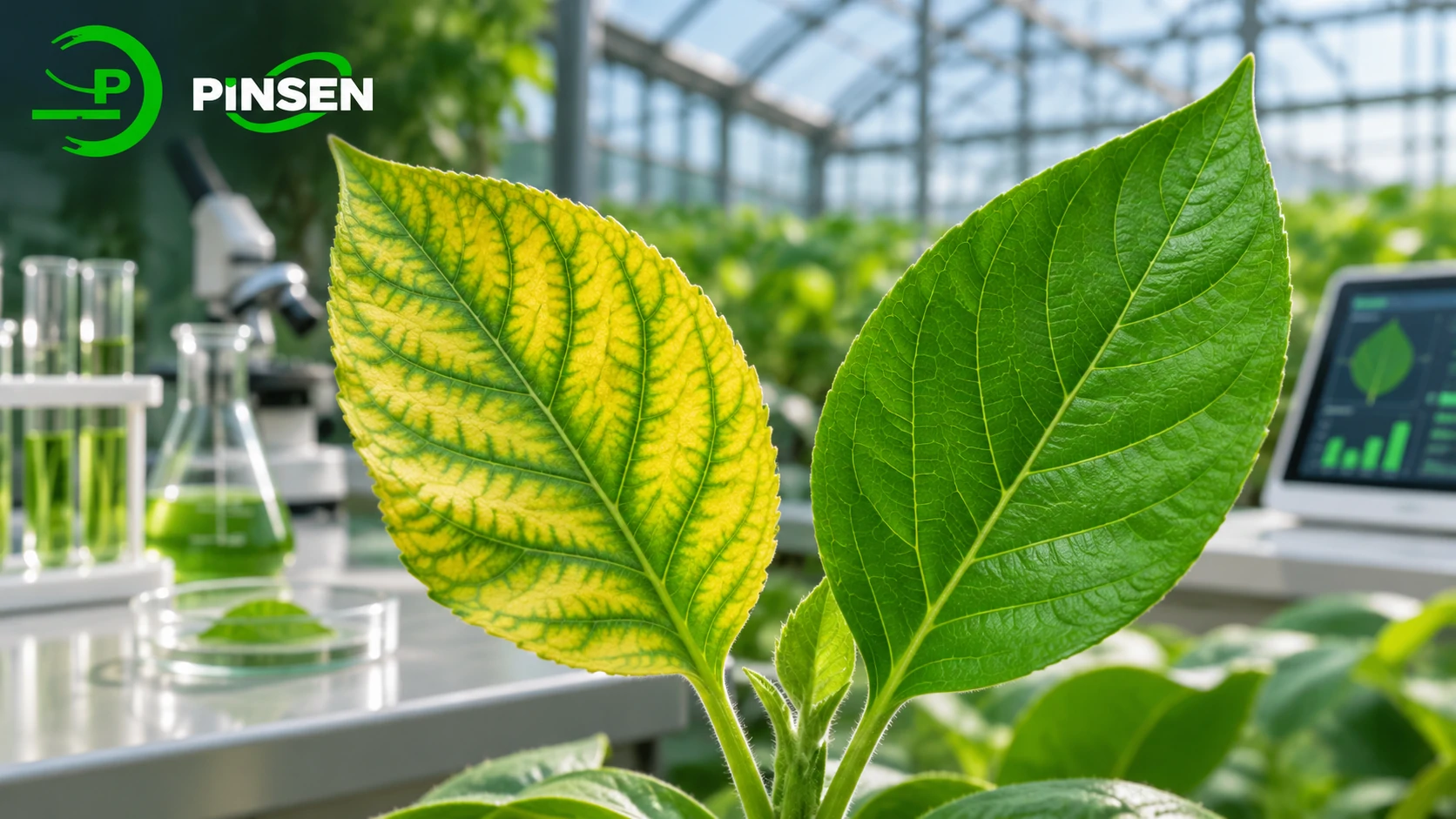
Nutrient management is the backbone of high-yield commercial farming. Among the secondary macronutrients, magnesium plays an irreplaceable role in driving photosynthesis and enzyme activation. When crops experience a shortage, they often exhibit a distinct physiological disorder known as leaf chlorosis. For agricultural input distributors, agronomists, and large-scale farm operators, understanding how to diagnose and correct this condition using PINSEN agricultural grade magnesium sulphate heptahydrate is vital for safeguarding crop quality and harvest value.
1. What is Leaf Chlorosis and How Does Magnesium Deficiency Trigger It?
Leaf chlorosis refers to the yellowing of plant leaves resulting from a failure to develop sufficient chlorophyll or the breakdown of existing chlorophyll pigments. Because magnesium ($Mg$) is the central metallic atom in the chlorophyll molecule—accounting for roughly 20% of a plant’s total magnesium—an inadequate supply immediately halts photosynthesis.
In most crop species, magnesium is mobile within the plant. When deficiency strikes, the plant relocates magnesium from older, lower leaves to younger, actively growing tissues. Consequently, visual symptoms typically appear first on mature leaves, manifesting as interveinal chlorosis—where the tissue between the leaf veins turns yellow while the veins themselves remain green. If left untreated in high-value crops like tomatoes, peppers, citrus orchards, and potatoes, this deficiency severely limits fruit sizing and overall yield.
2. Why Magnesium Sulphate Heptahydrate is the Industry-Standard Remedy
When agronomists need a fast-acting solution to correct acute magnesium deficiencies, Magnesium Sulphate Heptahydrate ($MgSO_4 \cdot 7H_2O$), commonly known as agricultural Epsom salt, is the compound of choice.
Unlike slower-release mineral rocks, heptahydrate crystals offer 100% water solubility. Upon dissolution, they immediately dissociate into bioavailable magnesium ions ($Mg^{2+}$) and sulfate sulfur ($SO^2-_4$). This dual-nutrient synergy not only restores green coloration and photosynthetic capacity but also improves plant nitrogen and phosphorus uptake efficiency. B2B buyers looking to diversify their agricultural chemical catalog can explore our complete bulk inorganic sulphate portfolio designed for global distribution networks.
3. Proven Application Methods for Commercial Agriculture
To achieve rapid recovery from leaf chlorosis, agricultural operators rely on two primary application techniques:
- Foliar Spraying (The Fast-Rescue Method): When crops display acute deficiency symptoms during critical vegetative or fruit-setting stages, foliar spraying provides immediate relief. Leaves absorb dissolved magnesium ions directly through their stomata, bypassing restricted root uptake channels in cold or waterlogged soils.
- Drip Fertigation and Soil Broadcasting: For continuous root-zone nourishment, dissolving heptahydrate crystals into irrigation water or blending them into base fertilizers ensures a steady supply throughout the growing season, preventing chlorosis from recurring.
4. Recommended Dosages and Best Practices
To maximize efficacy and avoid crop damage, commercial growers should adhere to professional application protocols:
- Foliar Concentration: Typically, a 1% to 2% solution (10g to 20g of magnesium sulphate per liter of water) is applied for standard field crops. For sensitive greenhouse vegetables, concentrations should be adjusted following local agronomic testing.
- Timing of Application: Spraying should occur during early morning or late evening when ambient temperatures are lower and stomata are fully open, enhancing absorption rates and preventing leaf scorch caused by intense sunlight.
- Tank Mix Compatibility: Magnesium sulphate heptahydrate is generally compatible with most water-soluble fertilizers and pesticides, though a jar test is always recommended prior to large-scale commercial tank mixing.
5. Sourcing High-Purity Agricultural Grade Heptahydrate from PINSEN
For fertilizer blenders and importers, partnering with a dependable manufacturing source ensures batch consistency and commercial success. As a direct-source manufacturer with 200,000 MT annual production capacity across three modern bases in Shandong, PINSEN applies rigorous quality control to every production run. Our products feature strict impurity controls, guaranteed water solubility, and robust export packaging options (such as 25kg PE-lined bags and 1250kg Jumbo Bags) tailored to withstand long-distance maritime transit.
Frequently Asked Questions (FAQ)
Q1: How quickly do crops show recovery after a magnesium sulphate foliar spray? A: Under optimal weather and soil conditions, visible greening and recovery from minor leaf chlorosis can be observed within 4 to 7 days following a foliar application. Severe deficiencies may require a follow-up application after 10 to 14 days.
Q2: Can magnesium sulphate heptahydrate be mixed with calcium-based fertilizers in irrigation systems? A: It is generally advised to avoid mixing high concentrations of magnesium sulphate and calcium nitrate in the same stock tank to prevent the precipitation of calcium sulfate (gypsum), which can clog drip irrigation emitters.
Q3: What export documentation does PINSEN provide with bulk shipments? A: Every shipment includes a verified batch Certificate of Analysis (COA), Material Safety Data Sheet (MSDS), commercial invoice, packing list, and certificate of origin. Pre-shipment inspections by SGS or BV are fully supported upon request.